
Call for Papers: WRENCH: RECLAIMING SILENT HERITAGE IN THE AGE OF CLIMATE CHANGE
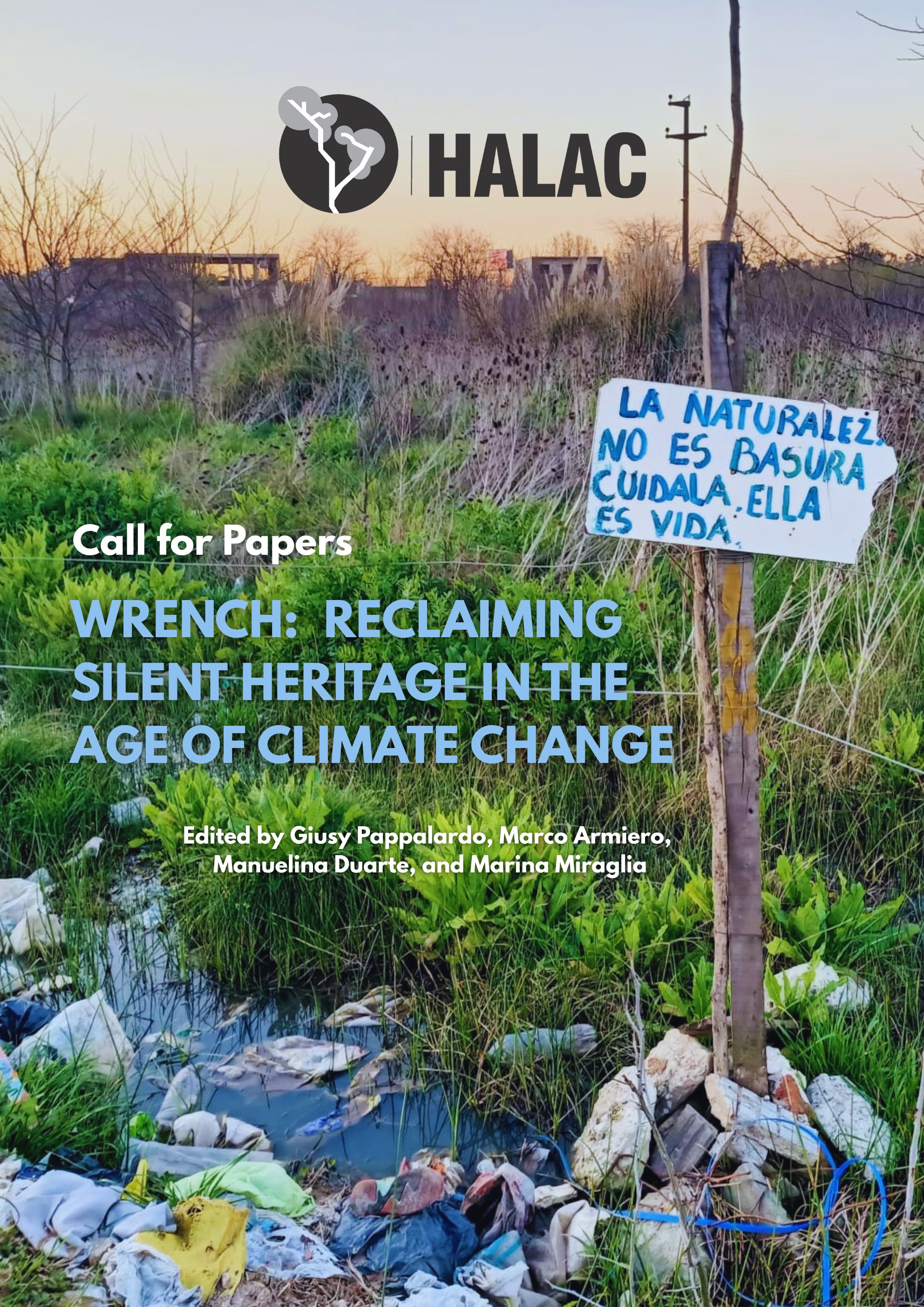
Source: Territorio de Memoria Indígena Tres Ombúes, along the Matanza-Riachuelo River, Ciudad Evita, Province of Buenos Aires, during a walk with the Comunidad Multiétnica Tres Ombúes. September 6, 2025. Author: Giusy Pappalardo
Heritage is a complex and often contradictory construct. Communities celebrate their heritage, whether a monumental temple, an iconic statue, or a traditional food. More recently, however, we have learned that such celebrations are less universal than once assumed (Smith, 2006).
Like ecology, heritage is also a battlefield. For a long time, the imposition of mainstream heritage silenced dissonant voices and neutralized conflict. This, in fact, has been the real “cancel culture,” erasing non-conforming stories and memories for generations. Indigenous, migrant, working-class, gender-based, and more-than-human narratives are examples of forms of heritage that have long been erased.
Today, subaltern groups are challenging mainstream heritage, questioning its legacy while creating insurgent practices of heritage-making (Novoa, 2022). From grassroots archives to the toppling or contestation of colonial and racist monuments, marginalized groups are rethinking heritage and their own past. The first step in this process is letting heritage speak again. Too often, heritage is silent, almost invisible, no matter how massive it might be. It has become part of a forgotten landscape—one we neither notice, nor question, nor ask what stories it might hold.
This is worsened even further by the most pressing challenges of our time. Among them, climate change intersects with the making and unmaking of heritage in two main ways. On one hand, it jeopardizes the survival of heritage sites through its effects. On the other hand, climate change itself could also become part of a forgotten or suppressed discourse: another neglected heritage, despite the risks it generates, especially for the most vulnerable groups.
In the face of this, heritage can be mobilized as a storytelling device to unveil climate change and its unequal impacts on human communities, while also engaging with more-than-human perspectives.
This special issue seeks contributions on the making/unmaking of heritage in Central and South America, merging critical heritage studies with research on the unequal effects of climate change, from a southern perspective (Castro Herrera, 2019). We welcome manuscripts on the following themes (though other related topics will also be considered):
- Landscape as integrated heritage: Transformations of more-than-human environments due to climate change and the loss of cultures and ecosystems.
- Indigenous heritage as narratives of survival — How does Indigenous heritage embody traces of annihilation and erasure, as well as resistance and survival?
- Mobile heritage: What does it mean to include migrants’ experiences in discourses on heritage? How do their stories intersect with environmental and climate change?
- Insurgent heritage: Where are the traces of rebellion and resistance? Who creates insurgent heritage? What can it say about the climate and environmental crisis?
- Toxic heritage: Industrial and environmental legacies of toxicity, as well as toxic narratives that turn communities into “social dumps” without history or identity.
- Heritage of disasters: How do communities remember (or forget) disasters? What are the multiple modes of remembering and oblivion?
- Heritage in danger: Material and immaterial heritage at risk of disappearing because of climate or environmental change.
- Ephemeral heritage: Beyond the monumental and durable, what about ephemeral heritage? How does it challenge the mainstream idea of permanence inherent to heritage?
- Working class heritage: What forms of heritage reflect struggles for social justice, and to what extent can these memories and narratives contribute to constructing alternatives to the dominant capitalist system?
- Gender-based heritage: What forms of heritage reflect the processes of empowerment that women and LGBTQ+ communities have undergone in recent decades, and to what extent might these experiences help frame a heritage of care?
We invite prospective authors to submit an extended abstract of approximately 1,000 words by March 16, 2026. Selected authors will then be asked to submit full manuscripts of up to 10,000 words (including footnotes) by May 31, 2026. Please note that being selected at the abstract stage does not guarantee publication: all manuscripts will undergo peer review and editorial board screening. Articles may be submitted in English, Portuguese, or Spanish.
For further information, please contact one of the editors listed below.
Giusy Pappalardo is a researcher currently based at the Institute for the History of Science at the Autonomous University of Barcelona, where she is involved in a transnational project and conducting research in the Matanza-Riachuelo watershed in Buenos Aires, Argentina. Her academic background is rooted in community-based planning, and her current work sits at the intersection of environmental humanities, critical heritage studies, and social museology. She earned her degree from the University of Catania in 2010 with a thesis examining the use of collective mapping as an empowerment tool for subaltern communities. From 2011 to 2014, she conducted doctoral research on ecological planning in the Deep South of the United States, supported by a Fulbright grant. Between 2016 and 2024, she served as a researcher at the University of Catania, where she continues to teach Landscape Planning. giusy.pappalardo@uab.cat
Marco Armiero is an ICREA Research Professor at the Institute for the History of Science, Autonomous University of Barcelona. He served as President of the European Society for Environmental History (2019–2022) and has been on the Board of Directors of the International Consortium of Environmental History Organizations since 2024. Formerly Director of the Environmental Humanities Laboratory in Stockholm (2013–2022), he has bridged environmental humanities and political ecology through his research. He is Editor-in-Chief of Resistance. A Journal of Radical Environmental Humanities. His book Wasteocene (Cambridge UP, 2021) has been translated into multiple languages. armiero@icrea.cat
Manuelina Maria Duarte Cândido is a professor of Museology at Federal University of Minas Gerais (UFMG), Brazil, and a permanent professor at the Graduate Programme in Social Anthropology at the Federal University of Goiás (UFG). She is a visiting professor in the Doctoral Programme in Sociomuseology at the Lusophone University, Portugal, where she is Editor of the collection Sociomuseology & Sociomuséologie. She was Professor of Museology at the University of Liège, Belgium, where she also worked for the Pole Muséal & Culturel and edited the journal Cahiers de Muséologie. She was a member of the board of ICOFOM LAC – Museology Committee of the International Council of Museums for Latin America and the Caribbean. She coordinated the Educational Action Sector at the Centro Cultural São Paulo, directed the Museum of Image and Sound of Ceará, and led the Museum Process Department at the Brazilian Institute of Museums. manuelin@uol.com.br
Marina Miraglia, PhD in Philosophy and Letters with a specialization in Geography (University of Buenos Aires). Postgraduate Professor of Environmental History at the University of Quilmes and undergraduate and postgraduate Professor of Geographic Information Systems at the National University of General Sarmiento (UNGS). Associate Professor, Director of the Higher Technical Program in Geographic Information Systems (both in-person and online), Coordinator of the Geographic Information Systems Laboratory and the Geographic Information Technologies and Spatial Analysis Area at UNGS. Currently, she is the Director of the Postgraduate Specialization in Thematic Cartography Applied to Spatial Analysis at UNGS and a member of the Academic Committee of the Specialization and Master's Programs in Environment and Sustainable Development at the University of Quilmes. mmiragli@campus.ungs.edu.ar
References
Castro Herrera, G. (2019). Sociedades, ambiente y ambientalismos en nuestra América. Historia Ambiental Latinoamericana y Caribeña (HALAC) revista de Solcha, 9(2), 45-63.
Novoa, M. (2022). Insurgent heritage: mobilizing memory, place‐based care and cultural citizenships. International Journal of Urban and Regional Research, 46(6), 1016-1034.
Smith, L. (2006). Uses of heritage. Routledge.